Wednesday, March 06, 2013

Little things


On February 24th, my eldest daughter had her first child, a boy.  I'm looking forward to meeting him for the first time in early April, but until then I have to be content with virtual visits and photographs.

This is the first sketch of my new grandson and I'm sure there will be many more to come.

Tuesday, March 05, 2013

Reynard II


Reynard the Fox was a medieval European trickster figure, a nasty but charismatic character who was always in trouble but always able to talk his way out of any retribution.

I'm not so sure whether this fellow is quite so willing to talk his way out of trouble.  He lies in wait in the grasses at the edge of the meadow, hidden enough from view but with full view of his surroundings.

Foxes have very cat-like features I think and quite delicate faces, legs and feet.  I've had quite a few encounters with them on the farm and just the other morning saw a silver fox race across the road as I left for work.  Red foxes are much more commonly seen so the silver one was a treat.

This fox is drawn on newsprint in pastel.  12" x 12" approximately.

Veiled


Drawing casts is a traditional method of learning to draw form.  All kinds of sculpture is used to draw from and good lighting helps the artist create the play of light and dark that gives the piece shape.

This is a form of gargoyle found on many buildings, little heads with various expressions that populate churches, cathedrals and buildings of importance.

This is a quick sketch done at lunch today that will be turned into a drawing.  I have vowed to produce several complete drawings this year and this will be one of them.  I think I hear charcoal calling for this one...

Monday, March 04, 2013

Reynard the Fox


Living in the country, there's always animals around.  Some wanted, some not so wanted.

Foxes are elegant opportunists.  They watch unseen from the woods and lurk on the edge of the field, waiting for a moment to grab a chicken or duck that's wandered too far or if very bold, they venture into the barn to see what's available.

Although I don't like it if they do kill one of the birds, I also have a degree of sympathy for them, as I know they're simply looking for a meal to feed themselves or a den of kits.

This sketch is the start of a small oil painting of Monsieur Reynard.  Drawing is the backbone of art and the need to draw and sketch daily pushes me to keep those hard earned skills intact.

You can add your sketch for one or all days in March on my March Sketch a Day page.  Simply add your name, blog post url and image to the Add my Link button on that page.

Sunday, March 03, 2013

Youth


 The classic lines in this fellow's face appealed to me and it may be worth expanding into a portrait.  For now, just a sketch.

Saturday, March 02, 2013

Afternoon stroll

 
Still in Vilnius, I came across this older woman out for a stroll in the dappled sunshine.  It seems the world over the stance, hair and accessories remain the same.  These sketches are being completed in a 3" x 5" trave e logue sketchbook.  The paper is fairly substantial and holds water well, so I thought I'd take advantage of that fact.

If you'd like to add your sketches during March, go to the March Sketch a Day page on my blog (see the page tabs above) and use the button to to add your image and link back to your blog post.  Let's see how many people will join in this month!


Friday, March 01, 2013

March sketching


Drawing has always been my comfort zone, but painting does eat into that and I while I usually sketch something most days, I don't usually share it.

I've decided that I will devote March to sharing a sketch a day.  One, it puts a bit of pressure on me to ensure that I do produce and two, it continues to ensure I keep my drawing skills honed.

I'll be posting the sketches in a Facebook album and also sharing them on my blog on the March Sketch A Day page.  I'd love others to join in and share what they've drawn during the month. You can add a thumbnail of your sketch on my March Sketch a Day page which also links directly to your blog post. The basis of the sketch should be a drawn line, but colour always livens things up after you have the "bones" down.

I'll start the month off with a sketch of a row of sheds on the side of a road in Vilnius, Lithuania.  If you're looking for something new to sketch try The Virtual Paint Out.  You never know what's waiting for you there!

Wednesday, February 27, 2013

Glass continued


I like the methodical build up of paint when working on something that is transparent. The  subtle changes in values are easy to miss, but become crucial in pulling off an object in realism.

This is why I rarely use a photograph if working from a reference piece but leave it on the computer. That way I can zoom in and see detail and colour that no printer, no matter what the quality of output, can ever produce. Here is the current work's progress, using layers of oils on top of the acrylic from the last post.

There's still lots more to do and I want to leave it for a couple of day to dry a little then start some glazes over the glass surface in some areas.

Monday, February 25, 2013

Painting glass


glass 2 sm

I've determined that my love of painting water and fish and reflective objects is all down to that play of light and how it forms shapes so well.  Capturing the reflective quality is a challenge to me and a bit like a puzzle that I always enjoy tackling. Glass tends to be one of those perceived difficulties for artists who view the whole and panic, wishing there was a "glass" paint to achieve the transparent and reflective surface.

Reflective surfaces need to be studied carefully to understand just what makes up their form.  When you dissect a highly reflective object in bright light, you see that the lines between values are very well marked and break the general rules in painting and drawing of not having crisp edges between values.   It is that edge that defines what we see and interpret and shiny.  If the bright light was not reflecting off the surface, the effect would still be there, but less intense.

glass oil 2 sm       glass oil 1 sm

Yesterday I created the study of a glass bottle (top of page) using watercolour in a 6 x 12 multimedia sketchbook.  I love my studies as many of you know and wanted to see if this would be worthwhile to turn into a painting.  And I believe it is. 

The form and reflections work well and I've drawn the bottle again freehand with acrylic paint and blocked in some form with dilute acrylic washes.  Next I'll start adding colour in oils.   Acrylic backgrounds are almost another form of study, letting me block in colour quickly to set the stage for what is to come. 

This is on a 9" x 12" canvas panel.

Saturday, February 23, 2013

Indiegogo project


I've taken the plunge and have launched an Indiegogo project to fund  my printmaking project Fishy Bits! in 2013.  Funding will help provide me with an entry level printing press as well as professional carving tools and supplies.


I'd be grateful if you could share this information with your networks.  The more people exposed to the message, the better chance I have of achieving my goal.  And of course, there are perks for contributions!  Contribution levels are available to suit every budget and if you can't contribute financially, sharing information on this project is as good as any contribution.  Facebook, Twitter, Google+, your blog, your website...anywhere!

Meanwhile, the March fish print has been carved and will be released on March 15th.  The January and February prints are completed and available from my website.  Happy fishing!

Friday, February 22, 2013

Reality and fantasy


So many beginning artists believe that fantasy work is all in your head. Its quite the opposite in fact, with reality front and centre.  The concept comes from within, but the creation is based on real objects and people.  The skill is in composition, and morphing real  into the unreal, which is still based on reality, if that makes sense.  For instance, a rabbit would never wear a jacket in reality, so my research is based on two images:  the first of a rabbit, the second of someone in that particular pose wearing a jacket.  Merging the two becomes simple once the idea is in place of putting an animal into a human pose.  Little touches of whimsy are added on as the piece progresses and my mind wanders.

My art group has been tossing around ideas for a new project that may or may not get off the ground - a Newfoundlandized version the classic story, Alice in Wonderland.  This is the thumbnail sketch of the Mad Hatter's tea party, or my version, in its infancy.  Of course in Newfoundland the best party always seems to gravitate to the kitchen, so of course, that is where the tea party would have to take place. I've been compiling little sketches here and there over a few weeks to see what ideas gel and how much complexity to put into something.  Even if they never make it into full paintings, the process gives a lot of food for thought and a lot of good practice on drawing and composition skills.

The beauty of creating something out of nothing is that it allows your mind to pull up memories, then flesh them out with solid research for forms. While very time consuming in terms of researching and drawing, the results prove quite interesting. 


Wednesday, February 20, 2013

Fractured duck

Duck Bucket 2

                                               Duck Bucket

                                                            5 x 7   oil

No, no don’t report me for duck abuse!  Its only the paint I fractured, not the duck!

I had downloaded a Artbyte tutorial on Daily Paintworks by Julie Ford Oliver on using fracturing in painting (thank you Julie!) and because I get side tracked easily from my main painting tasks, I thought I’d try it out using this image of one of my ducks from a few years back.   Also check out Celeste Bergin’s experiments with fracturing paint too  here and here.  Love that red chair!

I didn’t have the scraper tool that Julie adapted, so substituted a Catalyst rubber blade made by Princeton which was flexible and about an inch broad, but likely need to adapt a scraper to fit the bill.

I think my piece is more palette knife than paint fracturing, but it was fun to do and I may try again with a more refined technique instead of slapping on paint quite so lavishly.

The duck story?  I had quite a few ducks a number of years ago, and the white Pekins were one of my favourite.  Chatty, busy birds that made a line around the farm and laid lots of eggs as well as cleaning up grubs from the grass. They always  seems to be looking for something in the grass and if an inanimate object was found, they would “wash” it in their water bowl and there it would stay.

Pekin ducks LOVE water.  And yes, you say, ducks do.  But not all ducks do.  My Muscovy ducks didn’t like water much and BD, who I still have, really, really dislikes water except on days so hot he needs to cool down.  However, Pekin ducks make a beeline for any water.  A red bucket of water had been put out for them and a few minutes later I could hear scrabbling and quacking and went to investigate.   This duck got too excited and climbed into the bucket then, of course, couldn’t get out and had to be rescued.  Its a bit like having toddlers around.  You need eyes in the back of your head!

Never a dull moment around here!

Sunday, February 17, 2013

The fall back


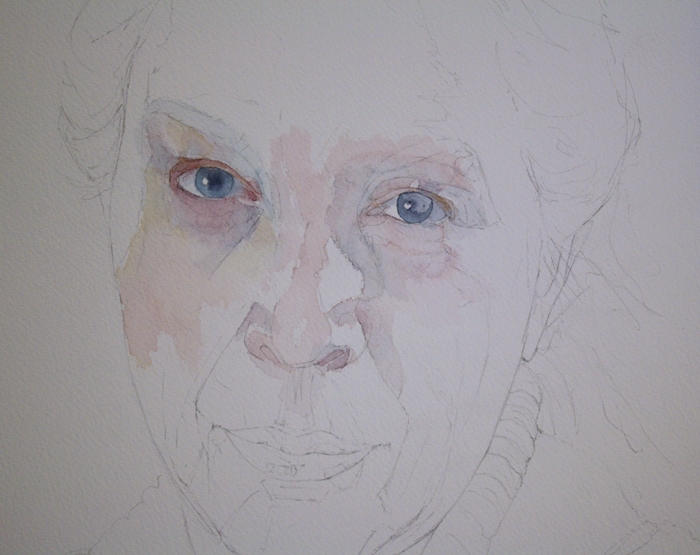
When inspiration isn't high or other things are on my schedule, I have a fall back.  Its me.  Or more precise, self portraits. They help me work out solutions, experiment with mediums and techniques and there's never much complaint from the model or any fees to pay.

The comfort level comes from familiarity.  After all these years, I know my face, good and bad, well.  I have the ability to see skin tones in an instant, adjust lighting to suit my needs and tweak without protest.  Self portraiture creates a historical record of features at a specific point in time. Not that future generations or public will hold me up as a celebrity, but they may be curious about the time or person that connects in some way to themselves.

When I think of generations long gone, I would love if they had recorded themselves in words and paintings for me to see and get a glimpse into their life, whether real or imagined.


I enjoy using watercolours for portraits.  They give a soft but strong impact and work so well for skin tones and eyes. I love seeing features appear out of the white paper as if by magic. This seems to happen more with watercolour for me than oils where I block in more colour at the start.  Of course I could do the same with watercolour, but I go with the eyes first then work my way out from there. I drew this out yesterday between bouts of doing other administrative tasks and started adding some colour today, again, between tasks.


Its not really a work in progress though you will see more complete versions appear in the future, provided the muse doesn't push me into another direction before that happens.

What's your fall back subject?

Thursday, February 14, 2013

Heart


I threw out a little challenge to other members of my local art group to come up with a heart for Valentine's Day.  The time limit was very short - I only considered the option on the drive home about 36 hours ago but a couple of people in the group joined in.

Unfortunately, the Arts Northeast blog won't let me post pictures tonight for some reason, so I'll show you what I created and hopefully the gremlins in the system will allow me to post on the ANE blog later.

This started out with a sheet of watercolour paper that I had gessoed tissue onto and let dry.  The resulting texture, with some additional string gel made a perfect surface that reminded me almost of veins and arteries running through the heart. A tiny bit of silver leaf finished it off.  Its about 5 x 7" and acrylic as I wanted quick dry time. 

I hope your V-Day was full of love.


Wednesday, February 13, 2013

Laid back

jessie 2 sm


Sometimes you just have to relax and goof around.  This is Jessie’s motto for life.  There are no pretentions, no trying to impress, its all about enjoying life and having a good time.  What you see is what you get and if you don’t like it, she doesn’t understand why and tries to persuade you otherwise.  We could all take a page from a dog’s approach to life and just go with the flow instead of fighting it every step of the way.

This was a loose sketch done in pastel on newsprint.  It was good to get loose and just let colour and shape guide my hand.  A piece of paper that’s big enough, forgiving enough and with no expectation of outcome.  I think I’m getting the canine insight into life already!

On another note, you may notice that my Etsy store widget is missing from my blog.  After a number of years of selling on Etsy, I have closed my shop.  I’ve found that Etsy no longer meets my needs.  The sellers are too numerous and its looking more like a shop browser’s paradise and difficult for a fine art collector to sift through the craft to local original art.  So I’m moving my small pieces for sale through my website at the moment and may try them on another small painting site in the future.  But for now you can find them on www.jeanettejobson.com

What has your experience  been with Etsy?  Have sales slowed over the last year?  Is there more craft than quality? Are fees an issue on Etsy or on other sites selling small pieces of fine art?  Where do you sell your small pieces?  Any input is always valuable.

Saturday, February 09, 2013

Winter Light


Pears are one of the most common subjects for painting and drawing.  Simple, but also complex to capture the values to produce that round shape.  I can't say that pears are my favourite thing to paint.  Their overuse makes them seem almost too common, however, revisiting simple shapes and interesting light is always a good warm up.

Here's a short video of the steps I took getting to the final piece.  I hate the red pear by the way it looks like a block of wood no matter what I do to it! :)


Thursday, February 07, 2013

Cecelia - SOLD

cecelia 2 sm
Cecelia - SOLD

Cecelia sat by the surf, contemplating yet another herring.  Yes, fish was good for the waistline, but her need for something more comforting was ever present.  With one more look at the sea, she took to wing, heading for the nearest McDonald's parking lot to barter with the crows for left over french fries.

Yes, another small painting. I’m  on a bird track but I do have other paintings in the wings, large pieces that will start to take shape over the next few days.

I do love birds of all kinds but haven’t painted many of them and not a seagull, well herring gull in this case.  I find seagulls fascinating and living on the sea there are always hundreds of them around and they always seem to hang out at fast food restaurants.  Easy pickings I presume.  They are huge birds with bad tempers and a love for a fight with most any other bird that crosses their path.  I recall a particular scary encounter with gulls at Paignton Zoo years ago at an outdoor restaurant.

Despite that, I still think they’re beautiful and deserve a large painting of their own soon.

Tuesday, February 05, 2013

Sparrow - SOLD

sparrow sm
Sparrow - SOLD

I can’t seem to settle into a major painting since before Christmas and keep producing studies or small paintings.  I have ideas for larger pieces in my head and filling sketchbooks but they don’t seem to translate onto paper or canvas.  I must buckle down and just produce and not let myself get side tracked.

This little house sparrow was one of the side tracks.   5” x 7” on stretched canvas in acrylics. 
And some interesting facts about house sparrows:

1. In 1883, House Sparrows were legally protected in Texas. There was a law that disallowed the killing of any sparrow back then.
2. The House Sparrow first came to North America in 1851, when it was introduced to Brooklyn, New York. From there, the House Sparrow population quickly spread to the Rocky Mountains and on to the West Coast, mainly due to introductions in San Francisco, California and Salt Lake City, Utah.
3. Incubation of eggs takes just 11 days, and two weeks later the young will leave the nest.
4. Most pairs will try and raise at least two and often three broods a year.
5. Their adaptability can be gauged by the fact that they have been found living and breeding 2000ft underground in a coalmine; others have been recorded living their whole lives inside warehouses

Friday, February 01, 2013

Orange study - SOLD

Morning Sunshine - SOLD

Pigments Through the Ages states:

The color we know as orange was referred to in Old English as “geoluhread,” which means yellow-red. The word “orange” was adopted after the eponymous fruit was introduced to English via the Spanish word naranja, which came from the Sanskrit word nāraṅga.

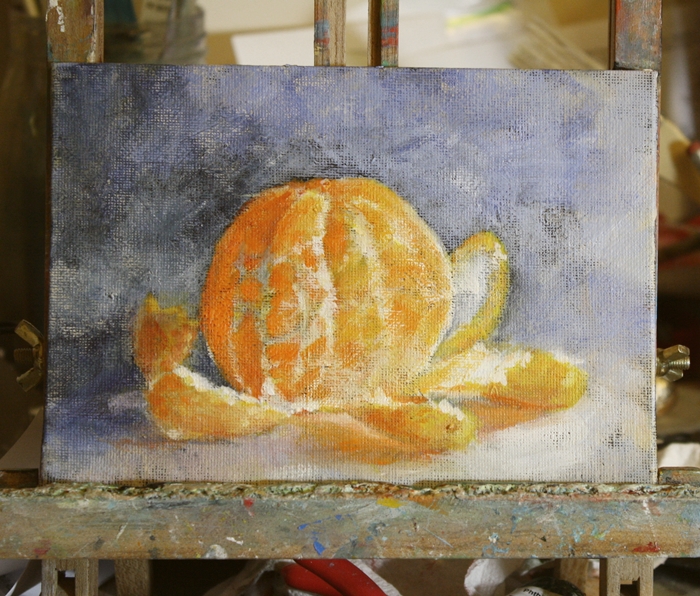
Orange and turquoise are my two favourite painting colours and they turn up over and over, especially in my fish paintings - well in most of my paintings you'll find traces of them.  The orange I like is pure pigment, cadmium orange is a warm colour which turns more towards yellow and my turquoise of choice (more like easy access/no mix) is Daniel Smith cobalt teal blue, however I do create my own turquoise using ultramarine and pthalo green with titanium white.  There are endless combinations of colours to create turquoise, depending on what value and warmth/coolness you want.

Still in acrylics I started this study of a clementine over a panel that I scrapped then restarted, using a black background over the offending part  of the original painting and leaving the perimeter pale.   Of course a form of blue and lavender crept in to offset the orange and there it was. No, not turquoise, but blues are never far away.
.

Monday, January 28, 2013

Blue Mussel

 To purchase, click here. $50


I couldn't settle on anything specific to paint tonight and decided to pull out my acrylics for some practice.  After using oils for quite awhile, there is always a bit of a learning curve in using acrylics again.  They're more common lately, as so many people have issues with oil paints and solvents and clean up is easier.

So hunting through my archives I found this little blue mussel shell.  These are so common in Newfoundland seen on every beach it seems and are grown commercially.  Unfortunately I am allergic to shellfish, so simply admire them from an artistic point of view.

This is on a 5" x 7" stretched canvas. I toned the canvas black and like the effect of a little darkness coming through the layers and will use the dark tone again I think.